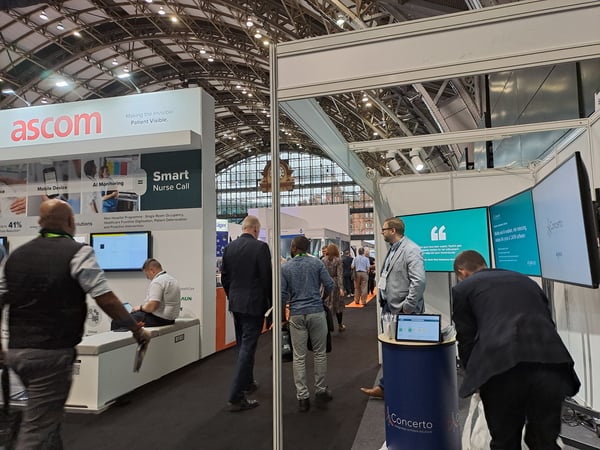
This guide compares five systems NHS trusts use to run the estate and complete the Premises Assurance Model (PAM). They are Concerto, SINGU, MRI Software, Ideagen Healthcare Guardian (formerly InPhase) and QuiqCare PAM from Quiq Solutions. Three are CAFM platforms with PAM reporting. Two are compliance tools built around PAM and wider governance.
The choice matters more since NHS England moved PAM to straight yes or no answers in April 2026. Every yes needs evidence, and every gap needs a cost to put it right. NHS England notes that the evidence is not stored in the PAM workbook itself, so it has to live somewhere the team can find it.
On this page
Key takeaways
- Concerto, SINGU and MRI are CAFM platforms with PAM reporting. Ideagen Healthcare Guardian and QuiqCare are compliance tools built around PAM and wider governance.
- Of the three CAFM platforms, only Concerto describes a dedicated PAM module on its website.
- The 2026/27 PAM asks for yes or no answers and a cost for every gap, so evidence and costs matter more than before.
- Four of the five are on G-Cloud 15. Concerto is also on NHS SBS Hard FM 3.
What is the NHS Premises Assurance Model?
The NHS Premises Assurance Model (PAM) is NHS England's framework for estates assurance. It shows a trust's board that the estate is safe, efficient, effective and of high quality. In NHS England's words, it "bridges the space between NHS boards and the operational detail" of estates and facilities work.
Every NHS trust must update its PAM each year and have it approved by the board. The data is shared with integrated care boards (ICBs), and the CQC tracks trusts that do not submit.
What changed in the 2026/27 PAM
NHS England published the 2026/27 PAM on 15 April 2026. It calls this the first year of a compliance-based approach.
- Yes or no answers. The five-level ratings, from outstanding to inadequate, are gone.
- Scores as a percentage. Each score is the share of yes answers.
- A cost for every gap. Where a trust is not compliant, it adds the cost to achieve compliance in a new finance tab.
- New domains. Safety (hard and soft), estates competency, patient experience and finance, with separate sections for helipads and the FM standard maturity framework.
What PAM software does
PAM software helps an estates team answer the self-assessment, hold the evidence behind each answer and track the actions that follow. Most tools share four parts:
- The self-assessment. The PAM questions, with an owner, a score and a history for each answer.
- An evidence library. Certificates, policies and inspection records stored once, with version control.
- Actions. Improvement actions with owners, due dates and reminders, carried into next year.
- Reporting. Results rolled up across sites for the board.
The biggest difference is where the evidence comes from. A standalone PAM tool holds the documents you upload to it. A CAFM system with a PAM module can also draw on the maintenance jobs, assets and certificates it already runs.
How we compared these systems
We asked five questions of each system. They are the questions NHS estates teams ask on a first call.
- Does PAM sit on the same data as maintenance and compliance? We checked whether the PAM answers can draw on the jobs, assets and certificates behind them.
- Is evidence stored once, with an owner? We looked for an evidence library with version control and a named owner for each question.
- Do actions carry over? We checked whether improvement actions are tracked after submission and into next year.
- Can it report across sites? Trust-wide roll-ups and board reports decide how much collation is left to do by hand.
- Does it meet NHS requirements? We looked for UK hosting, the NHS Data Security and Protection Toolkit, ISO 27001 and NHS buying routes.
Facts about each system come from the vendor's own website, read in November 2026. We review this guide every three months. If something has changed, tell us and we will correct it.
NHS PAM software compared
Scroll the table sideways to see every column.
| System | Best for | Type | PAM features described | Other NHS features | Security and buying routes | Named NHS customers |
|---|---|---|---|---|---|---|
| Concerto | Trusts that want PAM answered from live estate data | CAFM and IWMS with a PAM module | Self-assessment, evidence library, actions, trust-wide and board reports | Statutory PPM to room level, SFG20 link where you use SFG20 | DSPT, ISO 27001, Cyber Essentials; NHS SBS Hard FM 3, G-Cloud 15 | Manchester University NHS FT, North West Ambulance Service |
| SINGU (Micad) | Trusts that want space, CAFM and compliance from one group | CAFM and IWMS | PAM reporting | ERIC, water and fire (ZetaSafe), HTM | ISO 27001, Cyber Essentials Plus; G-Cloud 15 | Birmingham Community Healthcare NHS FT |
| MRI Software | Large trusts that want an enterprise CAFM | CAFM and IWMS | PAM reporting | ERIC, HTM monitoring, SFG20 | ISO 27001, Cyber Essentials Plus; G-Cloud 15 | King's College Hospital NHS FT, Essentia (Guy's and St Thomas') |
| Ideagen Healthcare Guardian | Trusts that run PAM through governance | Governance suite with a PAM module | Self-assessment, mobile evidence capture, actions, dashboards | Incidents (LFPSE), risk, CQC | DSPT, ISO 27001, Cyber Essentials Plus; G-Cloud 15 | Maidstone and Tunbridge Wells NHS Trust (Healthcare Guardian) |
| QuiqCare PAM | Teams replacing the PAM spreadsheet | Standalone PAM tool | All questions, evidence RAG rating, action plans, reminders, peer review | AE audit and HTM tool built with IHEEM | Not stated; no current G-Cloud listing found | Testimonials from three NHS trusts |
Read on each vendor's website and the G-Cloud Digital Marketplace in November 2026. "PAM reporting" means the vendor names PAM reporting but describes no PAM module.
The 5 best NHS estates and PAM systems
1. Concerto concerto.co.uk
Best for: NHS trusts that want PAM answered from live estate data, with CAFM on the same platform.
At a glance
- Made by
- Bellrock Technologies, part of the Bellrock Group since 2016
- Head office
- Liverpool Science Park
- Type
- CAFM and IWMS platform with a Premises Assurance module. The module can also be bought on its own
- PAM features
- Self-assessment aligned to the PAM questions, import of last year's submission, draft and final control, sign-off workflow, evidence library with version control, actions with reminders and escalation, RAG dashboards, trust-wide and board reporting
- Other NHS features
- Statutory PPM and reactive maintenance logged to room level, live SLA tracking, SFG20 link through Facilities-iQ where you use SFG20
- Mobile
- Native app for iOS and Android that works offline
- Security and hosting
- Microsoft Azure, UK data centres; ISO 27001, Cyber Essentials, NHS Data Security and Protection Toolkit; single sign-on
- Buying routes
- NHS SBS Hard FM 3, G-Cloud 15
- NHS customers
- Manchester University NHS Foundation Trust, North West Ambulance Service
- Pricing
- Priced by module, quoted per trust
Concerto is a CAFM and IWMS platform built in the UK. Its Premises Assurance module was co-designed with Manchester University NHS Foundation Trust, the UK's largest trust, and other NHS organisations have since adopted it. The partnership won Partners in Technology at the 2025 PFM Partnership Awards.
The PAM module runs on the same platform as the trust's maintenance, assets and compliance records. So the evidence behind a yes is the job, certificate or inspection that proves it. Trusts can also start with the PAM module alone and add maintenance later.
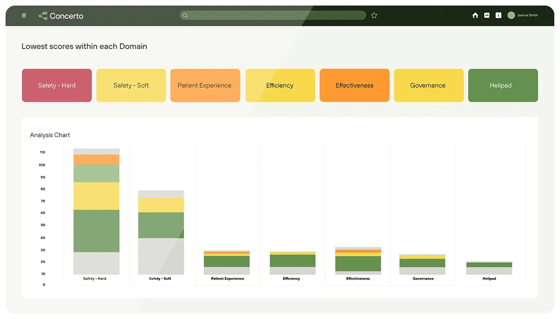
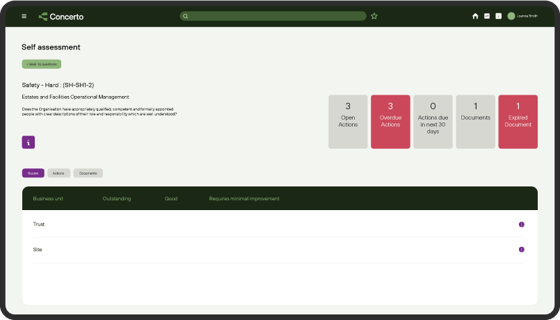
Evidence and ownership. Certificates, policies and records go into an evidence library with version control and a named owner for each question. Completeness checks show what is still missing.
Actions after submission. Each action has an owner, a due date, reminders and escalation alerts. Open actions carry forward into next year's return.
Trust-wide reporting. Results roll up across sites, and board-level reports come out in one click. Improvement is tracked monthly, quarterly and annually.
NHS customers. MFT runs nine hospital sites on Concerto and reports live to senior NHS leaders and regulators such as the CQC. North West Ambulance Service runs more than 130 sites in it.
What it does well.
- PAM sits on the same data as maintenance, assets and compliance.
- The module was built with an NHS trust and is in use at the UK's largest.
- It meets NHS buying and security requirements: NHS SBS Hard FM 3, G-Cloud 15, DSPT and UK hosting.
What to weigh.
- It is built for UK estates. It does not target multi-country rollouts.
- Prices are quoted for each trust. There is no public price list.
2. SINGU (Micad) micadsoftware.com
Best for: trusts that want space, CAFM, and water and fire compliance from one group.
At a glance
- Made by
- SINGU Group, which bought Micad in 2025 and Synbiotix in 2026
- Head office
- Kraków, Poland, with Micad's UK office in Altrincham
- Type
- CAFM and IWMS platform with ERIC and PAM reporting
- PAM features
- PAM reporting. We found no named PAM module, and no self-assessment, evidence or action features described
- Other NHS features
- ERIC returns, space and estate data, water and fire compliance through ZetaSafe, including HTM 04-01
- Mobile
- Native iOS and Android apps
- Security and hosting
- Microsoft UK data centres; ISO 27001, Cyber Essentials Plus
- Buying routes
- G-Cloud 15
- NHS customers
- Birmingham Community Healthcare NHS FT
- Pricing
- Not on its website. Listed in its G-Cloud 15 pricing document
SINGU is a CAFM and CMMS group that bought Micad, a UK estates software company founded in 1987, in 2025. It added Synbiotix, which makes soft FM software for hospitals, in February 2026. Micad says more than 180 NHS trusts use its software.
Its NHS strength is space and estate data, with ERIC and PAM reporting, plus water and fire compliance through ZetaSafe. Birmingham Community Healthcare NHS FT was the first NHS organisation to implement the SINGU CAFM platform.
What it does well.
- A deep NHS footprint: more than 180 trusts, by Micad's own count.
- ERIC and PAM reporting sit alongside space, CAFM and ZetaSafe compliance.
- Native apps, UK hosting, ISO 27001 and Cyber Essentials Plus.
What to weigh.
- We found no named PAM module, and no PAM self-assessment, evidence or action features described.
- The group is still bringing Micad and Synbiotix together, and its NHS counts vary by page, from 180+ to 200+.
3. MRI Software mrisoftware.com
Best for: large multi-site trusts that want an enterprise CAFM with ERIC reporting.
At a glance
- Made by
- MRI Software. The product, MRI Evolution, was called Concept Evolution until 2022
- Head office
- Solon, Ohio, USA, with a UK office in London
- Type
- CAFM, CMMS and IWMS
- PAM features
- Supports PAM reporting. We found no PAM self-assessment or action-plan module described
- Other NHS features
- ERIC reporting, HTM monitoring, PPM aligned to SFG20
- Mobile
- Native Android and iOS apps
- Security and hosting
- UK-hosted cloud; ISO 27001, Cyber Essentials Plus, SOC 2
- Buying routes
- G-Cloud 15
- NHS customers
- King's College Hospital NHS FT, Essentia (Guy's and St Thomas' NHS FT), St George's
- Pricing
- Not on its website. Listed in its G-Cloud 15 pricing document
MRI Evolution is the CAFM product of MRI Software, a property software group based in Ohio. MRI's healthcare page covers ERIC and PAM reporting, HTM monitoring and maintenance aligned to SFG20.
Its NHS references are strong. Essentia, the estates arm of Guy's and St Thomas', uses MRI Evolution, and King's College Hospital NHS FT uses MRI Software for estates management.
What it does well.
- A broad platform covering hard and soft FM, SFG20 maintenance, energy and IoT.
- NHS references at large London trusts.
- On G-Cloud 15, with ISO 27001, Cyber Essentials Plus and SOC 2.
What to weigh.
- PAM support is described as reporting only, with no self-assessment or action module.
- Its NHS customer figures vary across its own pages, from 150+ to 250+.
4. Ideagen Healthcare Guardian (formerly InPhase) ideagen.com
Best for: trusts that want PAM alongside incidents, risk and CQC compliance in one governance suite.
At a glance
- Made by
- Ideagen, which bought InPhase in 2024
- Head office
- Nottingham
- Type
- Quality and governance suite for healthcare, with a PAM module
- PAM features
- Self-assessment, evidence captured on phones and tablets, actions by prompt, question or domain, dashboards
- Other NHS features
- Incident reporting certified for NHS England's LFPSE, risk management, CQC and NICE compliance
- Mobile
- Browser-based, with no app to install
- Security and hosting
- Microsoft Azure; ISO 27001, Cyber Essentials Plus, NHS DSPT
- Buying routes
- G-Cloud 15
- NHS customers
- Healthcare Guardian at Maidstone and Tunbridge Wells NHS Trust and Sussex Community NHS FT. No PAM customers named
- Pricing
- Not on its website. Listed in its G-Cloud 15 pricing document
Healthcare Guardian is Ideagen's quality and governance suite for healthcare. It was called InPhase until Ideagen bought the company in 2024. Its PAM module sits next to incident reporting, risk management and CQC compliance.
It suits trusts where governance owns PAM as much as estates does. It is not a CAFM system, so maintenance and asset records live in another system.
What it does well.
- PAM sits in the same suite as incidents, risk and CQC compliance.
- Staff can capture evidence on phones and tablets, and track actions by question or domain.
- It holds the NHS DSPT, ISO 27001 and Cyber Essentials Plus.
What to weigh.
- It is not a CAFM. We found no link described between PAM answers and asset or maintenance records.
- Its public PAM material uses the older five-level rating. Ask for a demo of the 2026/27 version.
5. Quiq Solutions (QuiqCare PAM) quiqsolutions.com
Best for: estates teams that want a dedicated tool to replace the PAM spreadsheet.
At a glance
- Made by
- Quiq Solutions, part of The Citation Group since 2023
- Head office
- Wilmslow, Cheshire
- Type
- Standalone PAM compliance tool
- PAM features
- All the PAM self-assessment questions, evidence RAG rating, action plans with progress, reminders, users by domain, peer review
- Other NHS features
- AE audit and HTM monitoring tool built with IHEEM, covering water, fire safety, ventilation, medical gases and electrical
- Mobile
- Any browser
- Security and hosting
- Not stated on its website
- Buying routes
- No current G-Cloud listing found
- NHS customers
- Testimonials from staff at South West Yorkshire Partnership NHS FT, The Princess Alexandra Hospital, and East Suffolk and North Essex NHS FT
- Pricing
- Licensed per user. Prices not published
QuiqCare PAM is a compliance tool from Quiq Solutions, a Cheshire company that joined The Citation Group in 2023. It is built around the PAM itself: every self-assessment question, users by domain, reminders and action plans.
Its AE audit and HTM tool, built with IHEEM, runs on its own or links to the PAM questions. QuiqCare does not run maintenance, so the evidence comes from the documents the team adds.
What it does well.
- Built around the PAM, from the self-assessment questions to reminders and action plans.
- An AE audit and HTM tool built with IHEEM, covering water, fire, ventilation and medical gases.
- Staff at three named NHS trusts endorse it.
What to weigh.
- It is not a CAFM. We found no link described to asset or maintenance records, and no ERIC feature.
- Its PAM page still describes the older structure of 42 workbooks in six domains. Ask for a demo of the 2026/27 version.
How to choose PAM software for your trust
Most PAM demos look alike. These checks show the differences that matter after the first submission.
- Start from last year's return. Ask each vendor to import it in the demo. Then ask them to show where your gaps are.
- Ask to see the 2026/27 PAM. The April 2026 version moved to yes or no answers and added a finance tab for the cost of each gap. Check that the system handles both.
- Ask where the evidence comes from. A yes needs proof. Check whether the system can link an answer to the maintenance job, certificate or inspection behind it.
- Check that actions survive the deadline. Ask how open actions are tracked after submission and carried into next year.
- Ask for the board report. Ask the vendor to produce a trust-wide report from demo data, live. See how much collation is left to do by hand.
- Check NHS data security. Ask for the NHS Data Security and Protection Toolkit status, ISO 27001, UK hosting and single sign-on.
- Check the buying route. Ask which NHS and public sector frameworks the product is on, such as NHS SBS Hard FM 3 or G-Cloud 15.
- Speak to a trust like yours. Ask for a reference at a trust of a similar size, which has completed at least one PAM cycle in the system.
What we could not verify
- Prices. None of the five publishes prices on its website. Suppliers on G-Cloud 15 list theirs in pricing documents on the Digital Marketplace.
- NHS customer counts. SINGU's pages give 180+ and 200+ NHS trusts. MRI's give 150+ and 250+ NHS and healthcare clients.
- PAM customers. Ideagen names no PAM customers. Its NHS case studies cover Healthcare Guardian as a whole.
- Quiq Solutions' security. Its site shows a Cyber Essentials logo, but no hosting location, ISO 27001 or DSPT status. We found no current G-Cloud listing.
Final thoughts
All five systems can help a trust complete PAM. The difference is where the evidence comes from, and whether the PAM work connects to the estate it describes.
For trusts that want PAM answered from live estate data, with maintenance and compliance on the same platform, Concerto is a strong place to start. Its PAM module was built with the UK's largest trust and covers the self-assessment, evidence, actions and board reporting.
Other needs point elsewhere. Trusts already on Micad for space and ERIC may look at SINGU first. Large trusts that want an enterprise CAFM can compare MRI Software.
Where governance owns PAM, Ideagen Healthcare Guardian puts it next to incidents and risk. Teams that only want to replace the PAM spreadsheet can compare QuiqCare.
Frequently asked questions
What is the NHS Premises Assurance Model (PAM)?
PAM is NHS England's framework for showing a trust's board that the estate is safe, efficient, effective and of high quality. Trusts complete a self-assessment each year, and the board approves it.
Who has to complete NHS PAM?
NHS trusts must update it every year and have it approved by the board. NHS England designed it for all NHS providers, including foundation trusts and independent sector providers. It does not currently apply to primary care.
What changed in the 2026/27 PAM?
The April 2026 version moved to yes or no answers, in what NHS England calls the first year of a compliance-based approach. Scores are now the share of yes answers. Where a trust is not compliant, it adds the cost to achieve compliance in a new finance tab.
What is the best PAM software for NHS trusts?
It depends on where your PAM evidence lives and who owns the return. For trusts that want PAM answered from live estate data, Concerto is a strong option. Trusts that run PAM through governance often compare Ideagen Healthcare Guardian, and teams that only want to replace the spreadsheet can compare QuiqCare.
Can we use PAM software without a CAFM system?
Yes. Standalone PAM tools exist, and Concerto sells its Premises Assurance module on its own. The trade-off is evidence: on its own, a PAM tool holds what you upload. Linked to a CAFM system, it can draw on the maintenance jobs and certificates behind each answer.
How does PAM relate to ERIC?
ERIC, the Estates Returns Information Collection, is the annual return of estates and facilities data that NHS trusts submit. PAM is a self-assessment of whether the estate is safe, efficient, effective and of high quality. Both draw on the same estate data, so a system that holds that data can support both.
Is Concerto available on NHS frameworks?
Yes. Concerto is available on NHS SBS Hard FM 3 and Crown Commercial Service G-Cloud 15. It holds the NHS Data Security and Protection Toolkit, ISO 27001 and Cyber Essentials, and is hosted in UK data centres.
Who designed Concerto's PAM module?
It was built with Manchester University NHS Foundation Trust, around the problems its estates and facilities teams faced. MFT uses it to monitor compliance across hundreds of properties, and other NHS organisations have since adopted it.